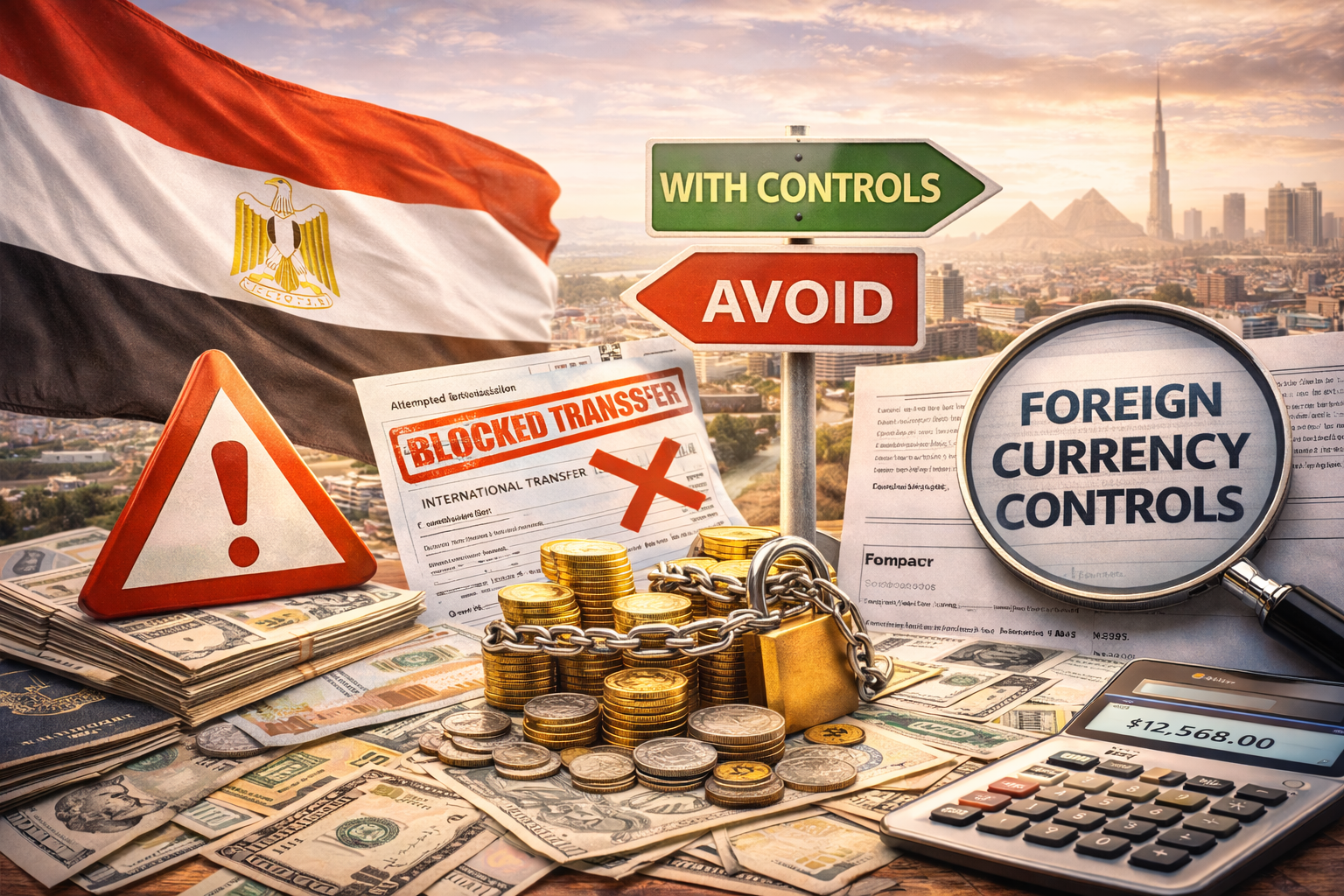
For foreign investors and businesses operating in Egypt, foreign currency controls are an unavoidable reality.
Even when profits are generated locally, converting funds into foreign currency or transferring them abroad can be difficult. These controls are not temporary measures, but part of a broader policy framework aimed at stabilizing foreign reserves and the exchange rate.
Discussions often focus on how to “bypass” currency controls. In practice, however, attempting to circumvent regulations usually creates greater risk.
A more sustainable approach is to design investment and business structures with currency controls as a given.
Ignoring the system can result in frozen funds, blocked transfers, or regulatory complications that undermine the entire investment.
Experienced investors tend to adopt realistic strategies, such as:
These approaches share a common theme: reducing reliance on short-term capital movement.
While currency controls are often seen as obstacles, understanding them is a critical element of risk management.
Knowing what transactions are allowed, when currency conversion is possible, and which routes are realistic helps investors avoid unexpected disruptions.
Investing in Egypt requires letting go of the assumption that capital can always move freely.
Instead, investors must focus on:
This shift in mindset is essential for sustainable engagement with the market.
Egypt’s foreign exchange controls undoubtedly impose limitations.
Yet they also define the framework within which successful investments must operate.
Rather than searching for shortcuts, investors are better served by understanding the system and working within it.
This pragmatic approach is key to building resilient, long-term investment strategies in Egypt.




Please feel free to contact us from the email form.

 Inquiries by email
 Bookmark
 Browsing history




 Bookmark
 Browsing history


