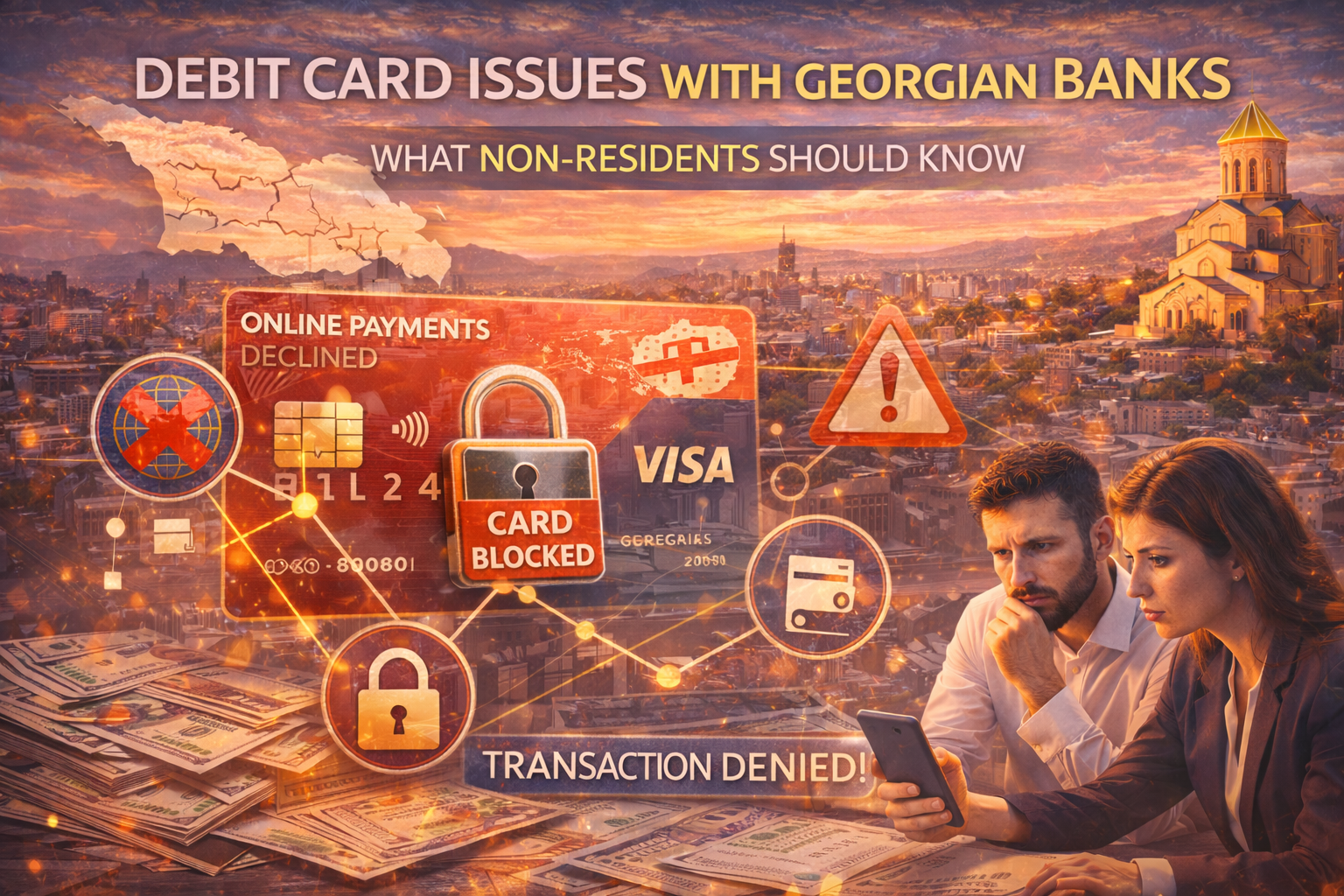
Many foreigners who open bank accounts in Georgia report that while account opening itself is relatively smooth, debit card usage can be unexpectedly restrictive.
These issues are particularly common for non-resident account holders, who may face limitations not immediately explained at the time of account setup.
Non-residents frequently encounter problems such as declined online transactions, regional usage restrictions, sudden card suspensions, or repeated requests for additional verification.
These are not system errors, but outcomes of banks’ compliance and risk-control policies.
From a bank’s perspective, non-resident accounts involve higher uncertainty.
Limited visibility into residency status, transaction purpose, and cross-border activity increases perceived risk.
As a result, debit card usage is often tightly controlled from the outset.
This creates a gap between expectations and actual usability.
Non-residents can minimize inconvenience by checking usage settings in advance, avoiding unusually large or frequent transactions, preparing explanations for transaction purposes, and relying on more than one payment method.
Treating the card as a secondary tool rather than a single all-purpose solution is especially important.
Georgian debit cards work well for everyday local spending.
However, for international e-commerce, subscriptions, or frequent overseas use, limitations are more likely to appear.
This is not unique to Georgia, but a common characteristic of non-resident banking worldwide.
Debit card issues in Georgia are rarely insurmountable — but they do require realistic expectations.
For non-residents, understanding the constraints and planning usage accordingly is key.
When treated as a situational tool rather than a universal solution, Georgian debit cards can still play a useful role in personal financial management.








Please feel free to contact us from the email form.

 Inquiries by email
 Bookmark
 Browsing history




 Bookmark
 Browsing history


