Investment in overseas real estate.
Purchase and seminar information site egypt-realestate
Bookmark
Browsing history
Language
日本語
English
中文
العربية
Español
Русский
Investment Property
Rental Property
Column
Online Seminar
For Agents
Free Consultation
Investment in overseas real estate.
Purchase and seminar information site egypt-realestate
Bookmark
Browsing history
Language
日本語
English
中文
العربية
Español
Русский
Bookmark
Browsing history
Menu
Free Consultation
Investment Property
Rental Property
Column
Online Seminar
For Agents
Form For Agents
Company Profile
Site Map
Privacy Policy
Investment in overseas real estate.
Purchase and seminar information site egypt-realestate
Bookmark
Browsing History
Language
日本語
English
中文
العربية
Español
Русский
Investment Property
Rental Property
Column
Online Seminar
For Agents
Free Consultation
Bookmark
Browsing History
Menu
Free Consultation
Investment Property
Rental Property
Column
Online Seminar
For Agents
Form For Agents
Company Profile
Site Map
Privacy Policy
Colomn for Overseas real estate investment
TOP
Colomn for Overseas real estate investment
2026/01/13
Managing a Georgian Bank Account Long-Term — What 8+ Years of Practice Reveal
Georgia
Opening an Account Is Easy — Maintaining It Is Not When people discuss overseas bank accounts, the focus is often on whether an account can be opened.In reality, the far greater challenge lies in maintaining the account over time without issues. As global compliance and anti–money laundering standards have tightened, bank accounts are no longer “set and forget.” Ongoing management is now essential. Why Georgian Banks Have Attracted Foreign Clients Georgia has gained attention for offering a relatively accessible banking environment for foreigners. Key factors include English-language support, user-friendly online banking, international transfer capabilities, and openness toward non-resident clients. These features have made Georgian banks appealing to investors, entrepreneurs, and internationally mobile individuals. What Long-Term Use Really Requires Experience supporting accounts for over eight years shows that challenges rarely appear at the opening stage. Instead, issues tend to arise later, such as: Periodic document updates Requests to clarify transaction purposes Verification of fund sources Consistency between account usage and declared objectives Failure to respond properly can result in restrictions or even account suspension. What “Full Support” Truly Means Effective long-term support goes far beyond paperwork assistance. It involves understanding the bank’s perspective, maintaining a consistent narrative about account usage, aligning transaction history with actual business activity, and adapting to evolving regulatory expectations. This comprehensive approach is what allows accounts to remain functional over many years. Key Considerations for Overseas Account Holders An overseas bank account is a powerful tool — but only if managed carefully. Account holders should regularly reassess why the account exists, how it is used, and whether all transactions can be clearly explained in the future. Without this awareness, even well-established accounts can suddenly become unusable. Conclusion: Longevity Defines Real Value The true value of a Georgian bank account is not how easily it can be opened, but how reliably it can be used over the long term. In an increasingly strict global financial environment, sustainable account management has become a critical element of effective international asset management.
Click here for column details
2026/01/10
Emerging Companies Gain Attention in Nigeria’s Strong Stock Market
A Positive Shift in Nigeria’s Equity Market Nigeria’s stock market has recently drawn growing attention as one of Africa’s more dynamic equity markets.Despite challenges such as inflation and currency volatility, equities have attracted capital and shown resilient performance. A key factor behind this trend is the rise of emerging companies operating in growth-oriented sectors. Why Emerging Companies Are in Focus Historically, Nigeria’s economy relied heavily on oil and gas. Today, however, new growth engines are becoming more visible. Sectors such as: Financial services Telecommunications and technology Consumer goods Infrastructure-related industries are expanding rapidly, driven primarily by domestic demand. These companies benefit directly from population growth, urbanization, and increased economic participation. The Strength of Domestic Demand With one of the largest populations in the world, Nigeria possesses a powerful internal market.This domestic demand helps support corporate growth even when global conditions are uncertain. Many of the emerging companies gaining investor interest focus on essential services, financial inclusion, and everyday consumption — areas that tend to offer resilience across economic cycles. Investment Appeal from a Long-Term Perspective Nigeria’s equity market offers more than short-term growth potential. Key attractions include: An underdeveloped market with room for valuation expansion A young and growing population Long-term structural demand At the same time, investors must remain mindful of risks such as currency fluctuations and regulatory uncertainty, making careful selection and diversification essential. From Resource Dependence to Growth Economy Nigeria is gradually redefining itself.While natural resources remain important, the economy is evolving toward a more diversified, consumption-driven model. The rise of new listed companies reflects this transition, highlighting how domestic challenges are being transformed into business opportunities. Conclusion: What Emerging Firms Reveal About Nigeria’s Future The strong performance of Nigeria’s stock market is closely tied to the progress of its emerging companies. Their growth is not a temporary phenomenon, but part of a longer-term shift supported by demographics, urban expansion, and rising domestic demand. To understand Nigeria’s investment landscape, it is increasingly important to look beyond market indices and focus on which companies are driving the next phase of growth.
Click here for column details
2026/01/09
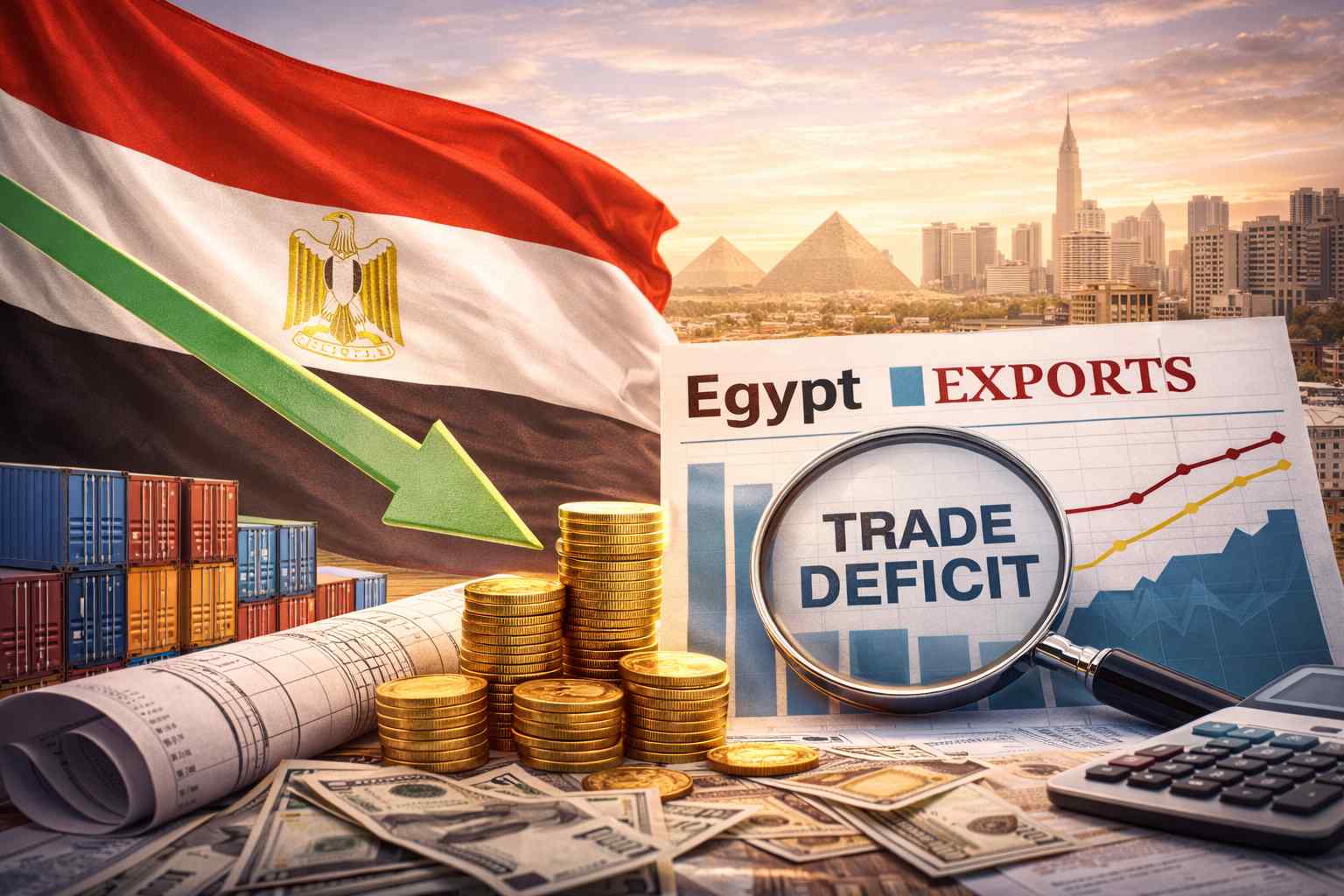
Egypt’s Trade Deficit Falls to a 10-Year Low — Signs of Structural Change Beyond Oil
A Notable Shift in Egypt’s Trade Balance Egypt’s trade balance has recently shown a significant improvement, with the trade deficit falling to its lowest level in nearly a decade. This development suggests more than a temporary economic fluctuation. It points to a gradual transformation in the country’s economic structure and external trade dynamics. The Growing Role of Non-Oil Sectors A key driver behind the narrowing deficit is the expansion of exports from non-oil sectors. While Egypt remains an energy producer, it has been steadily diversifying its economy. Manufacturing, agricultural processing, chemicals, and construction materials have all contributed to stronger export performance. This diversification reduces reliance on energy markets and helps stabilize foreign-currency earnings. Exchange Rates and Import Adjustment Another factor behind the improvement is a shift in import behavior. Currency depreciation has increased the cost of imports, encouraging businesses and consumers to prioritize domestic production and reduce non-essential imports. Although challenging in the short term, this adjustment can support long-term industrial development and competitiveness. Signs of Greater Economic Resilience Countries with persistent trade deficits often face pressure on foreign reserves and currency stability. Egypt has long dealt with such vulnerabilities. The recent trend suggests progress toward a more resilient external balance, supported by broader export bases and improved trade discipline. While challenges remain, the direction of change is structurally meaningful. Implications for Investors and Businesses From an investment perspective, a narrowing trade deficit carries important implications: Improved foreign-currency stability Reduced macroeconomic risk Expanding opportunities in non-oil industries These factors enhance Egypt’s appeal for long-term investment, particularly in export-oriented and industrial sectors. Conclusion: Looking Beyond the Numbers Egypt’s reduced trade deficit is not just a statistical improvement. It reflects a deeper shift toward economic diversification and structural reform. Understanding these underlying changes — rather than focusing solely on headline figures — is essential for assessing the country’s future economic trajectory.
Click here for column details
2026/01/08
The “Exit Problem” in Crypto — A Practical Reality Highlighted by ROMA
Other/Investment
Why Exiting Crypto Is Harder Than Entering In crypto investing, attention is often focused on price appreciation and potential gains. Yet experienced investors quickly realize that the real challenge lies elsewhere. The most difficult question is not how to buy, but how to exit — how to convert digital assets into usable, real-world value. Without a clear plan for where, how, and under which rules profits will be realized, even significant gains remain theoretical. Why the Exit Problem Matters The complexity of crypto exits goes far beyond market volatility. Different jurisdictions apply different regulations and tax treatments. Exchanges can change rules without notice. Banks may question or block incoming funds. Tax obligations often arise the moment profits are realized. As asset values increase, these issues become more serious, making exit planning essential rather than optional. ROMA’s Exit-First Perspective What distinguishes ROMA’s approach is its focus on designing systems with exits in mind from the beginning. Rather than emphasizing speculation alone, the framework considers: How value is transferred How assets connect to real-world use How compliance and practical usage are handled This represents a shift from speculative crypto toward functional, usable digital value systems. From Speculation to Practical Use The crypto market is gradually moving from a speculative phase to one where usability, integration, and sustainability matter. In this environment, assets that clearly define how value can be realized — legally and practically — gain credibility. ROMA’s direction reflects this broader maturation of the market. A More Realistic Investor Mindset For today’s crypto participants, the key questions are changing: How will profits be realized? Which jurisdiction governs the exit? Are compliance and taxation considered in advance? Success now depends not only on entry timing, but on having a clear and workable exit strategy. Conclusion: Exit Planning Signals Maturity Thinking about exits is a sign of serious, mature investing. ROMA’s message is not about hype, but about connection — connecting digital assets to the real economy in a sustainable way. As the crypto space evolves, projects that can clearly explain their exit pathways will stand apart from those that cannot.
Click here for column details
Category
Egypt
Georgia
Other/Investment
Dubai/UAE
Archive
January 2026
December 2025
September 2025
August 2025
July 2025
April 2023
Contact Us
Free consultation / Inquiries
Please feel free to contact us from the email form.
Inquiries by email