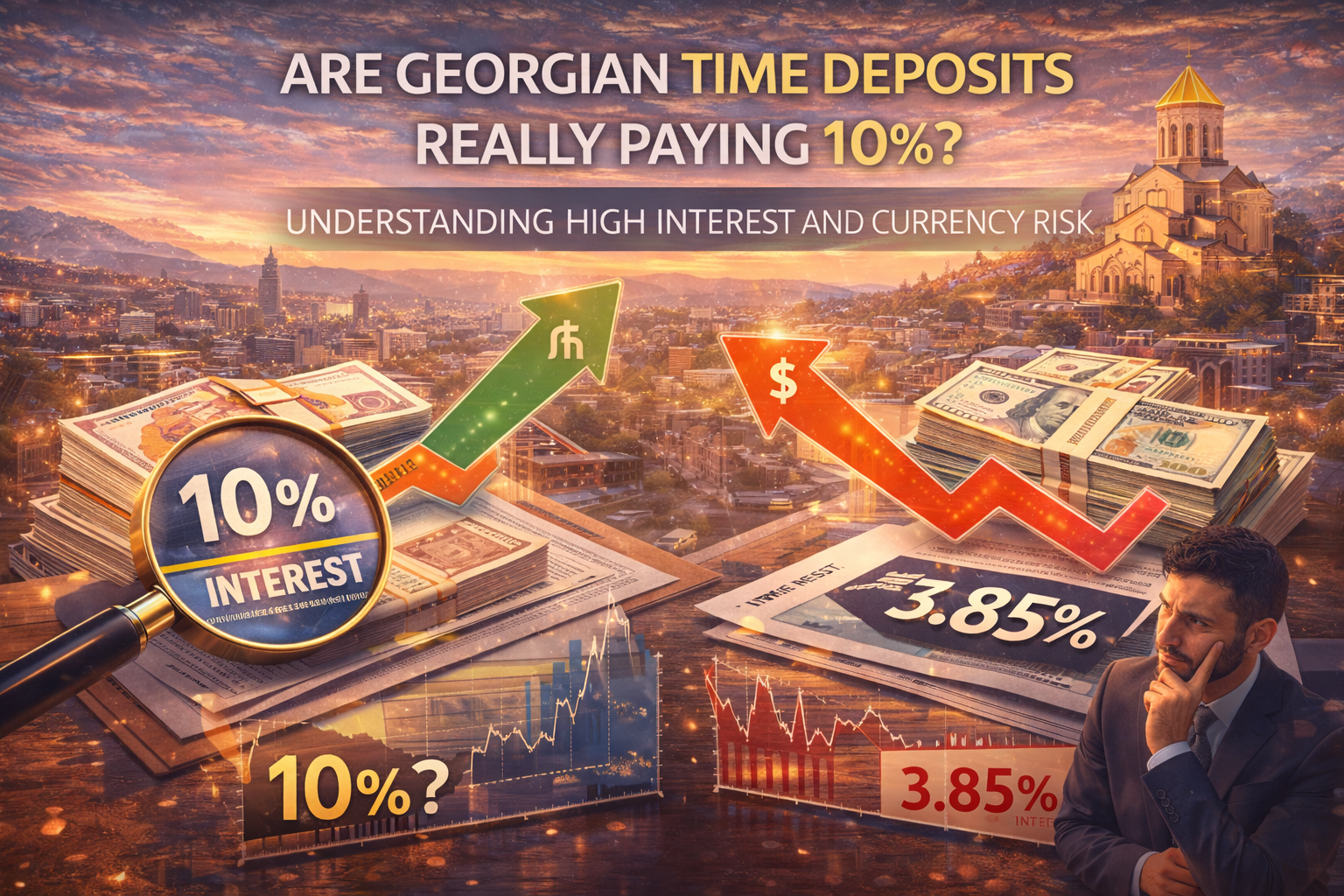
Georgia’s bank time deposits are often highlighted with interest rates around 10%, a striking figure in today’s low-interest global environment.
However, focusing on the headline number alone can be misleading without understanding the conditions behind it.
It is true that Georgian banks offer relatively high interest rates — but most of these rates apply to deposits denominated in Georgian Lari (GEL).
Interest rates on USD- or EUR-denominated deposits are significantly lower.
This means the advertised rate must always be considered together with the currency involved.
High interest rates come with currency exposure.
Even if a GEL-denominated deposit earns 10% interest, depreciation of the local currency can offset or eliminate gains when measured in foreign currency or home currency terms.
What appears attractive on paper can look very different after exchange rate movements are factored in.
High interest rates are not unique to Georgia.
In many emerging or smaller economies, rates are set higher to compensate for inflation, currency volatility, and economic risk.
In this context, interest is best seen as risk compensation, not a free advantage.
Anyone considering Georgian time deposits should evaluate:
High interest does not automatically mean high returns — it usually signals higher uncertainty.
Georgian high-interest deposits may suit investors who can tolerate currency fluctuations, use them as part of a diversified portfolio, and focus on medium- to long-term positioning.
They are less suitable for those prioritizing capital stability above all else.
Georgia’s time deposit rates are undeniably high by global standards.
But the real question is not the size of the interest rate — it is how that rate interacts with currency movements and personal investment goals.
Understanding the full picture behind the “10%” figure is essential for making informed and balanced financial decisions.





Please feel free to contact us from the email form.

 Inquiries by email
 Bookmark
 Browsing history




 Bookmark
 Browsing history


