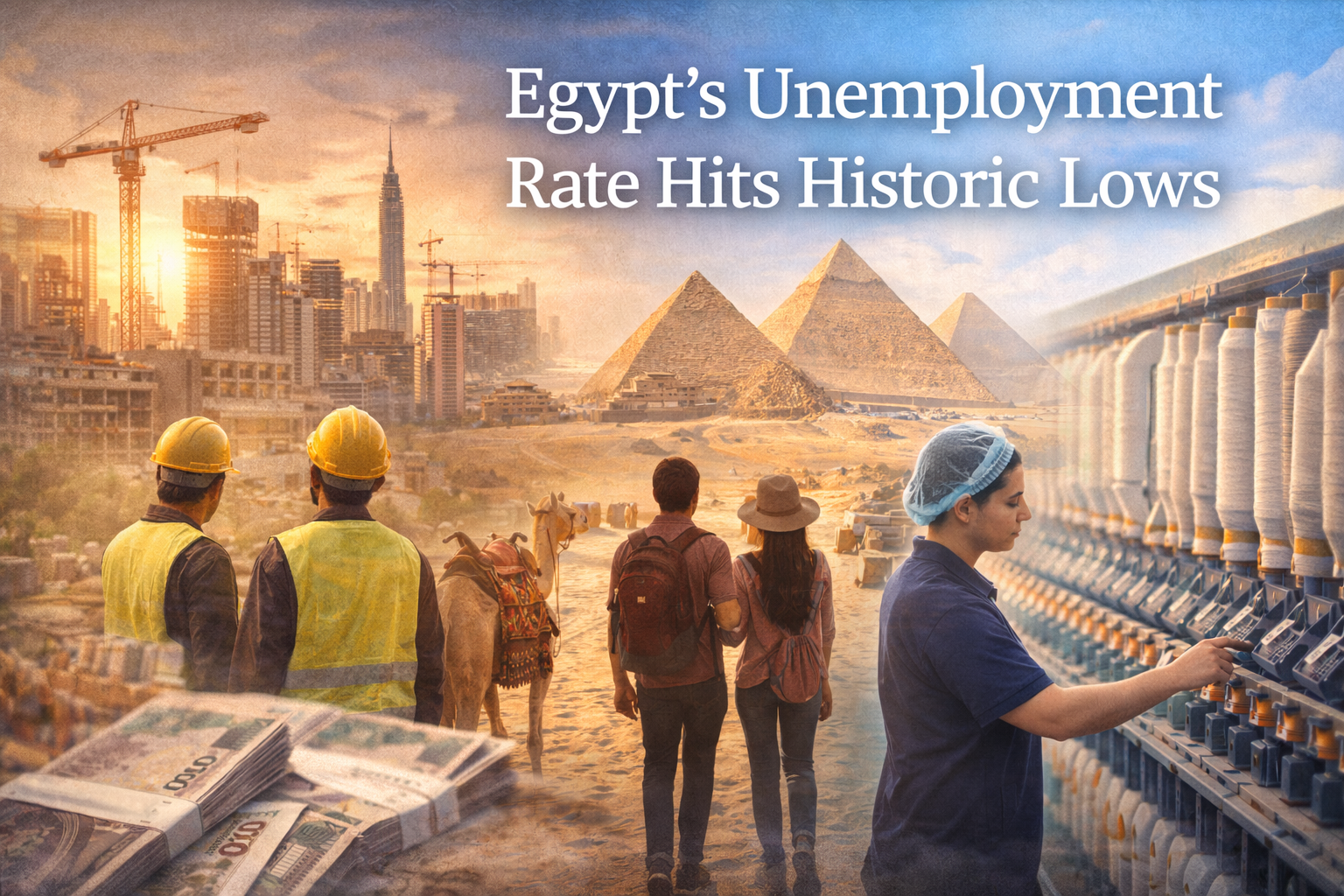
Egypt’s unemployment rate has recently fallen to historically low levels, marking a notable milestone in its economic trajectory.
Unemployment is often seen as a key indicator of economic health.
The critical question, however, is whether this decline reflects structural improvement or temporary stimulus-driven growth.
Several factors contribute to the improving employment figures:
Construction and public investment projects, in particular, have absorbed significant portions of the labor force.
A lower unemployment rate does not automatically guarantee long-term stability.
Important qualitative factors include youth employment levels, female labor participation, and the proportion of informal work.
Given Egypt’s young population, sustainable job creation remains essential.
The durability of employment gains depends on which sectors are expanding.
Public works may provide short-term relief, but private-sector growth, export industries, and diversified services offer more stable foundations.
Developments in textiles, tourism, and manufacturing will be key indicators moving forward.
Improving employment supports consumption growth and social stability.
Higher employment typically translates into stronger housing demand, increased retail activity, and urban expansion.
For investors, labor market trends serve as important signals for long-term economic momentum.
Egypt’s declining unemployment rate is an encouraging development.
However, its long-term significance depends on whether employment growth is structurally embedded within the economy.
Looking beyond the numbers to assess quality and sustainability will be crucial in evaluating Egypt’s next stage of development.








Please feel free to contact us from the email form.

 Inquiries by email
 Bookmark
 Browsing history




 Bookmark
 Browsing history


