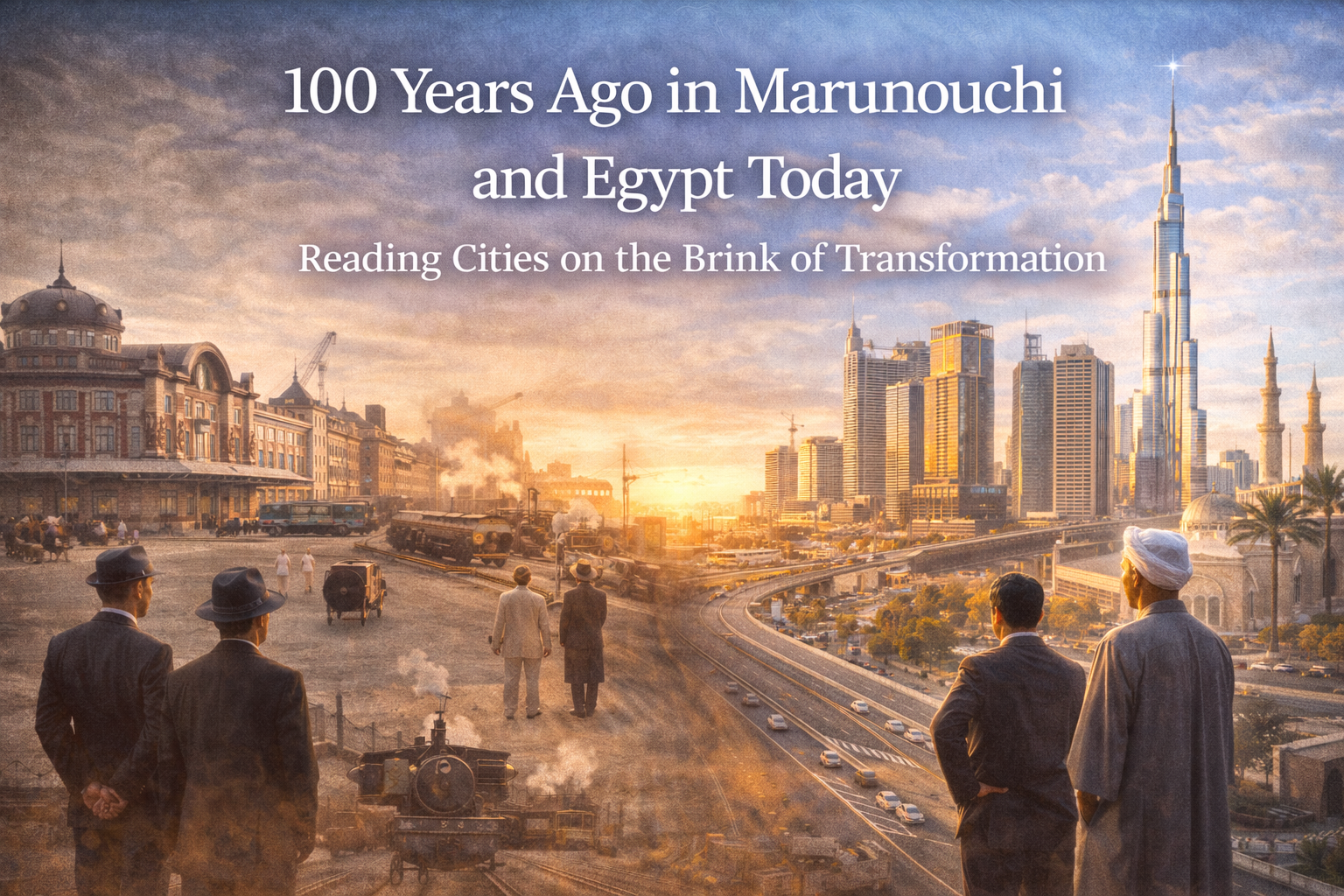
Imagine Tokyo’s Marunouchi district a century ago.
It was far from the global financial center it is today.
Yet the foundations — infrastructure, planning, and long-term vision — were already in place.
At the time, it did not look like a finished city.
It was a city at the threshold of transformation.
Modern Egypt, particularly its New Administrative Capital, presents a comparable moment.
Marunouchi’s rise was supported by railway networks, office district planning, and systematic development.
Similarly, Egypt is investing heavily in infrastructure:
During early phases, such developments often appear excessive — until growth catches up.
In the initial phase of urban expansion, there may be visible vacancies, underutilized spaces, and gradual population inflow.
This does not necessarily indicate failure; it reflects a transitional period.
Few observers could fully envision Marunouchi’s future a century ago.
The key question is not current appearance, but long-term direction.
Egypt’s population exceeds 100 million, with a significant youth demographic.
Its strategic geographic position, control of the Suez Canal, and expanding domestic market strengthen its development potential.
Population scale and geographic leverage are critical components of sustainable urban growth.
Urban transformation unfolds over decades.
Evaluating such development through short-term metrics can obscure long-term potential.
Egypt today represents an evolving structure rather than a completed model — a phase where opportunity and uncertainty coexist.
History does not repeat itself identically, but patterns often rhyme.
What once seemed incomplete can later define a nation’s economic core.
The future of high-growth cities is visible only in hindsight.
Recognizing transformation while it is still unfolding is what separates observation from long-term vision.




Please feel free to contact us from the email form.

 Inquiries by email
 Bookmark
 Browsing history




 Bookmark
 Browsing history


